
A place to start.
A context to understand.
The Digital Twin connects locations, assets, relationships and dependencies. A spatial representation is an interface into that contextual model, not its entire definition.
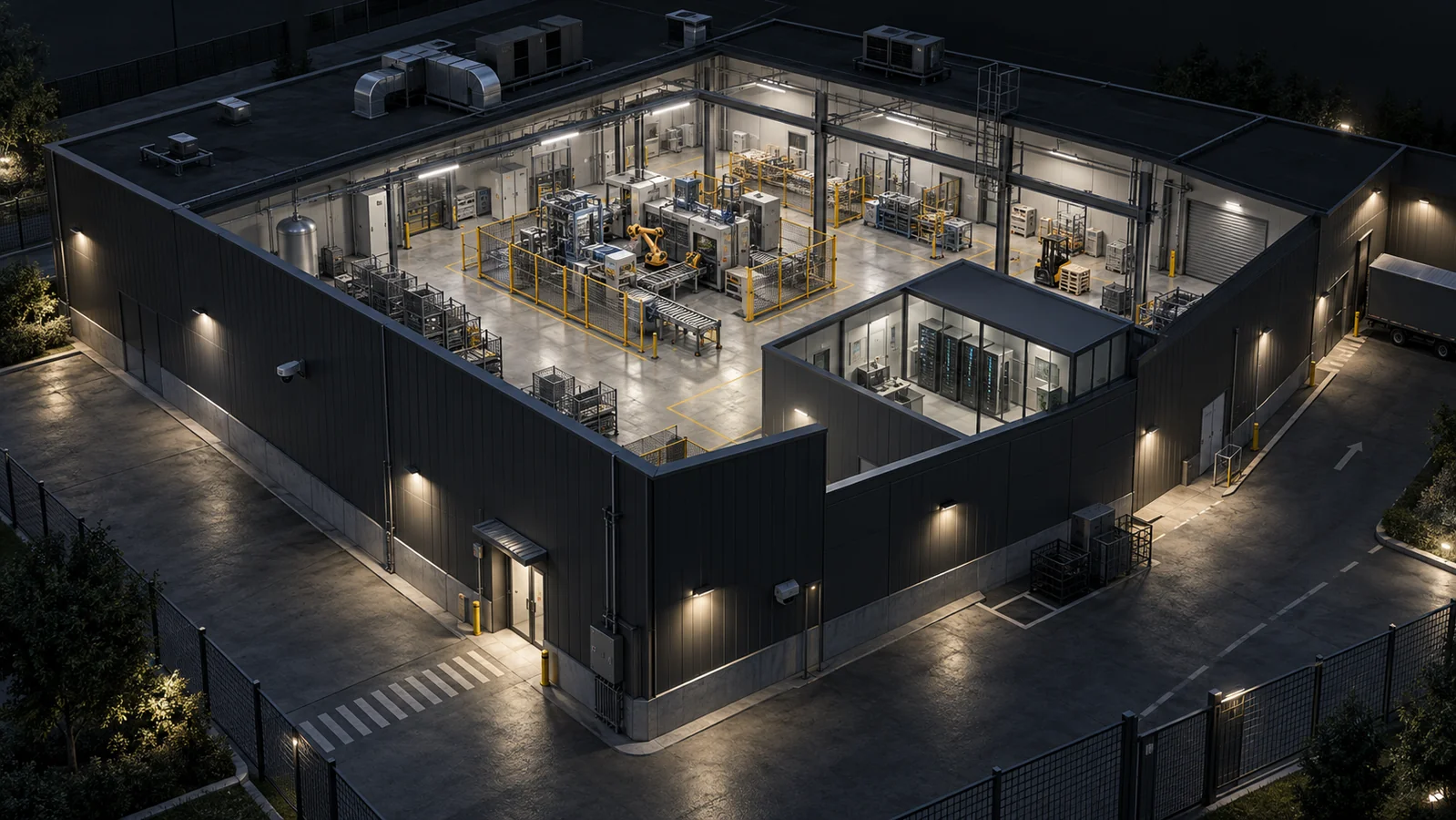
Start with the place.
Production A gives observations a shared physical context. A site, room or operational zone is more useful than an isolated address.
THE CONTEXTUAL MODEL
Every relationship needs a reason.
A location anchors an observation. An asset identity connects records. A relationship describes a link; a dependency describes what may rely on it.
How evidence is qualified- Provenance
- Which source supports this link?
- Freshness
- When was the supporting evidence observed?
- Uncertainty
- Which relationships are declared, observed or still unverified?
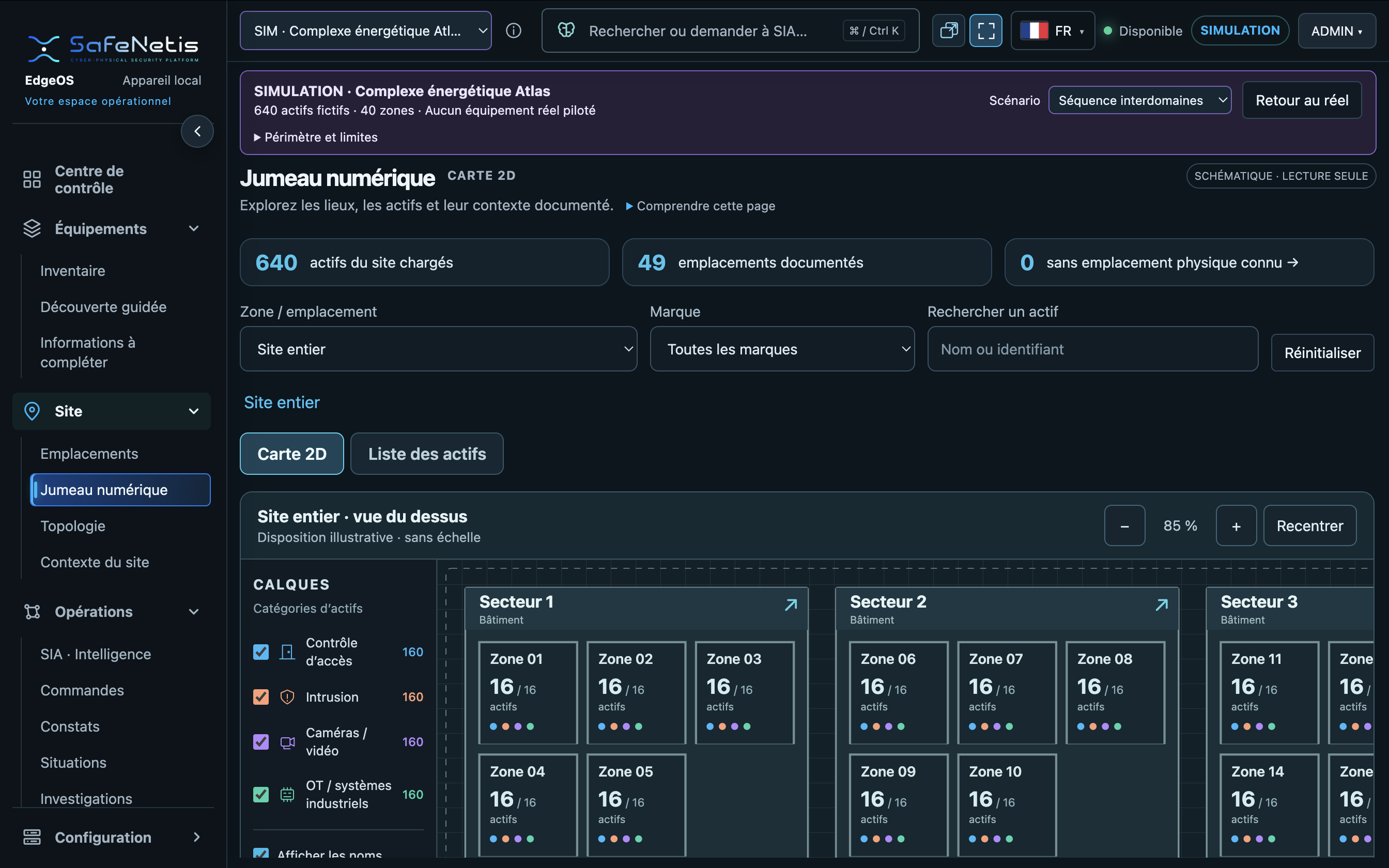
ACTUAL PRODUCT CAPTURE · ATLAS · SCHEMATIC 2D MAP
The current product view.
The Atlas interface is a schematic, read-only 2D map of fictional locations and assets. The spatial model above illustrates the wider direction; it is not a live product capture.
MODEL BOUNDARIES
Visible context. Explicit limits.
Planned
Deeper correlation and richer digital-twin modeling remain product direction.
Requires validation
Coverage depends on authorized and accessible sources.
Correlation is not causality.
Location and network dependencies connect physical-security observations to IT evidence. A relationship supports an investigation; it does not prove a cause.
SAFENETIS